Technical skills assessments have become the foundation of modern engineering hiring. Yet just a few years ago, most technical hiring teams still relied heavily on resumes, recruiter screenings, and live whiteboard interviews to evaluate engineers. While common, these methods were often slow, inconsistent, and prone to favouring candidates who performed well in interviews rather than those who could demonstrate strong real world coding skills.
Today, the landscape looks very different. AI powered assessment platforms can simulate real coding environments, score submissions objectively, verify candidate identity, and even predict job performance from skills data.
The hard part now is not whether to use a technical assessment platform. It’s choosing the right one.
What hiring teams should evaluate
Before comparing vendors, it helps to define what “best” actually means for your organization.
- Assessment accuracyDoes the platform reliably identify candidates who can perform on the job, not just solve trivia style puzzles?
- Candidate experienceTop engineers abandon clunky or overly adversarial interviews. The platform should feel modern, fair, and relevant to real work.
- AI and automationLeading tools now offer AI assisted scoring, interview insights, skill benchmarking, and automated workflows.
- Security and integrityFor remote hiring, features like identity verification, plagiarism detection, browser monitoring, and proctoring matter.
- Breadth of rolesSome platforms excel at competitive coding. Others are better for enterprise hiring across engineering, data, cloud, DevOps, and emerging AI roles.
- Hiring outcomesThe ultimate question is simple: does the platform improve time to hire, quality of hire, and interview to offer conversion?
The top platforms in 2026
1. Glider AI – Best overall for enterprise technical hiring
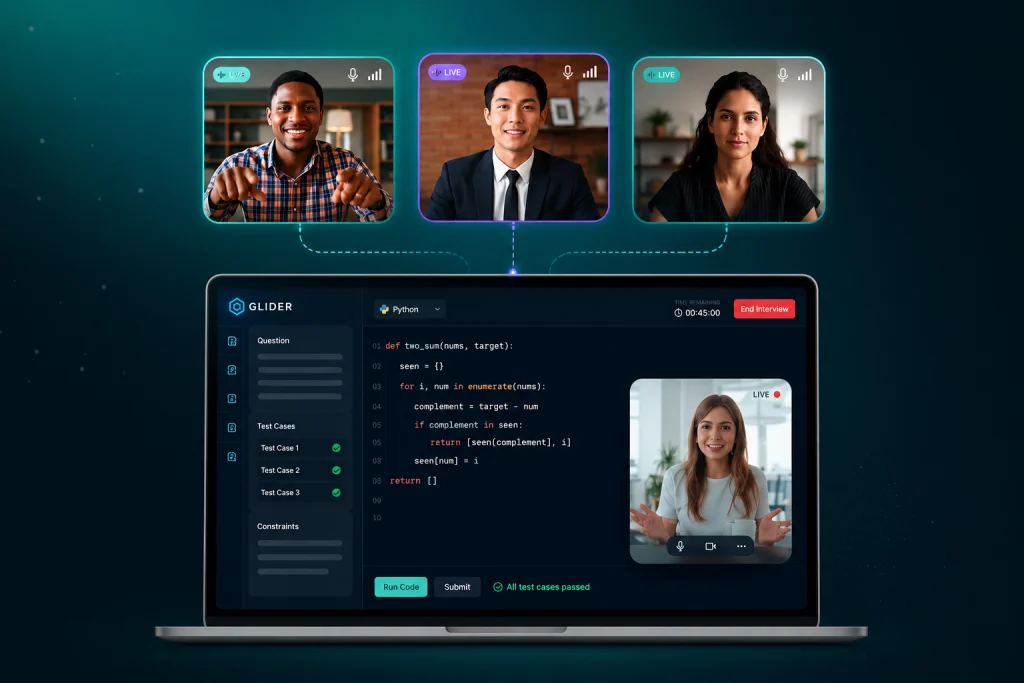
Best for: enterprises that want a full AI powered hiring workflow, not just coding tests.
Glider AI stands out because it combines skills assessments, AI coding interviews, identity verification, and talent intelligence in one platform. Instead of treating assessments as a standalone screening step, it connects them to broader hiring outcomes.
Why it ranks highly
- AI generated and adaptive coding interviews
- Real world project simulations rather than only algorithmic puzzles
- Built in ID verification and anti cheating controls
- Strong analytics for skills benchmarking and hiring quality
- Integrations with enterprise ATS and HR systems
Best use cases
- Large scale engineering hiring
- Global remote recruitment
- Teams prioritizing candidate authenticity and skills intelligence
- Organizations hiring across multiple technical roles, including AI, cloud, and data engineering
Potential trade offs
- More enterprise focused than lightweight SMB tools
- Broader feature set may be more than a small startup needs initially
2. HackerRank – For developer friendly coding environments
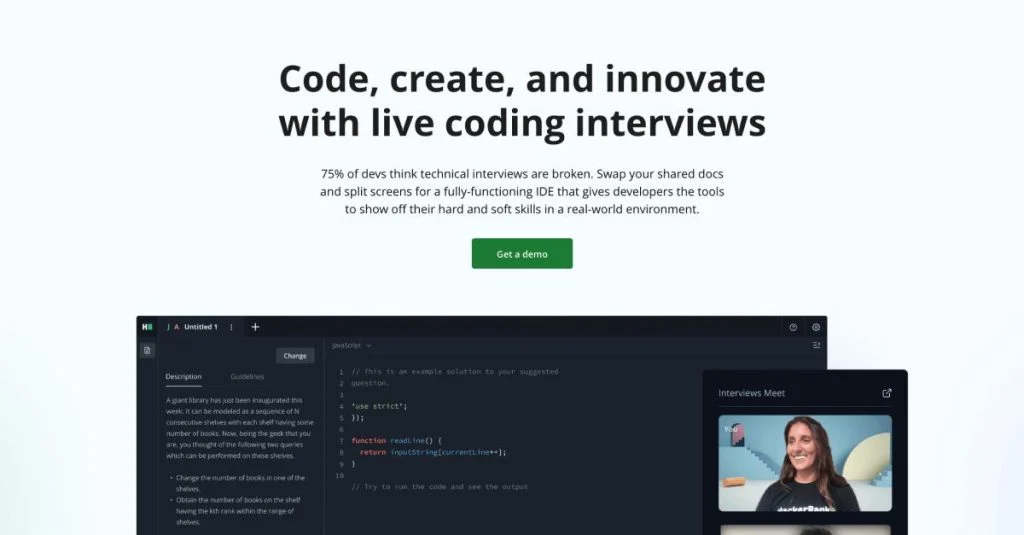
Best for: companies that want a familiar, developer centric coding interview experience.
HackerRank remains one of the most recognized names in technical hiring. Engineers often know the interface already, which can reduce candidate friction.
Strengths
- Excellent coding environment and language support
- Large library of coding challenges
- Strong brand recognition among developers
- Good support for live pair programming interviews
Limitations
- Heavier emphasis on coding challenges than end to end hiring intelligence
- Enterprise analytics and AI capabilities are less differentiated than newer platforms
3. Codility – For standardized engineering evaluations
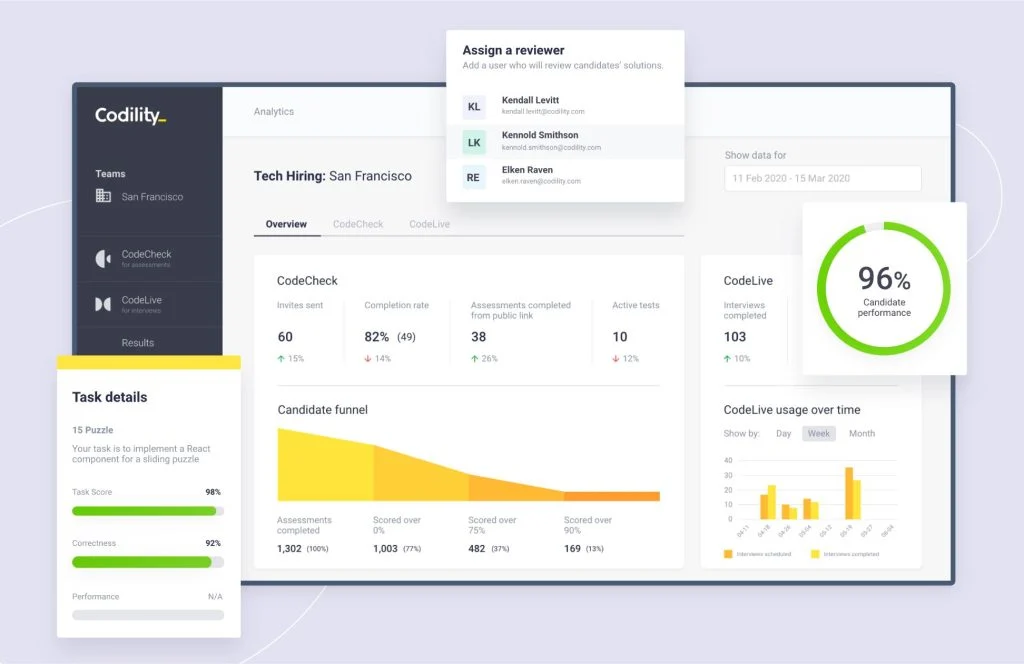
Best for: organizations that want structured, repeatable assessments with strong reporting.
Codility is widely used by enterprises for screening and interviewing software engineers at scale.
Strengths
- Reliable standardized assessments
- Detailed scoring and benchmarking
- Good scalability for high volume hiring
- Solid enterprise administration controls
Limitations
- Candidate experience can feel more test centric than collaborative
- Less emphasis on AI driven interview insights
4. CodeSignal – For skills benchmarking and certification style testing
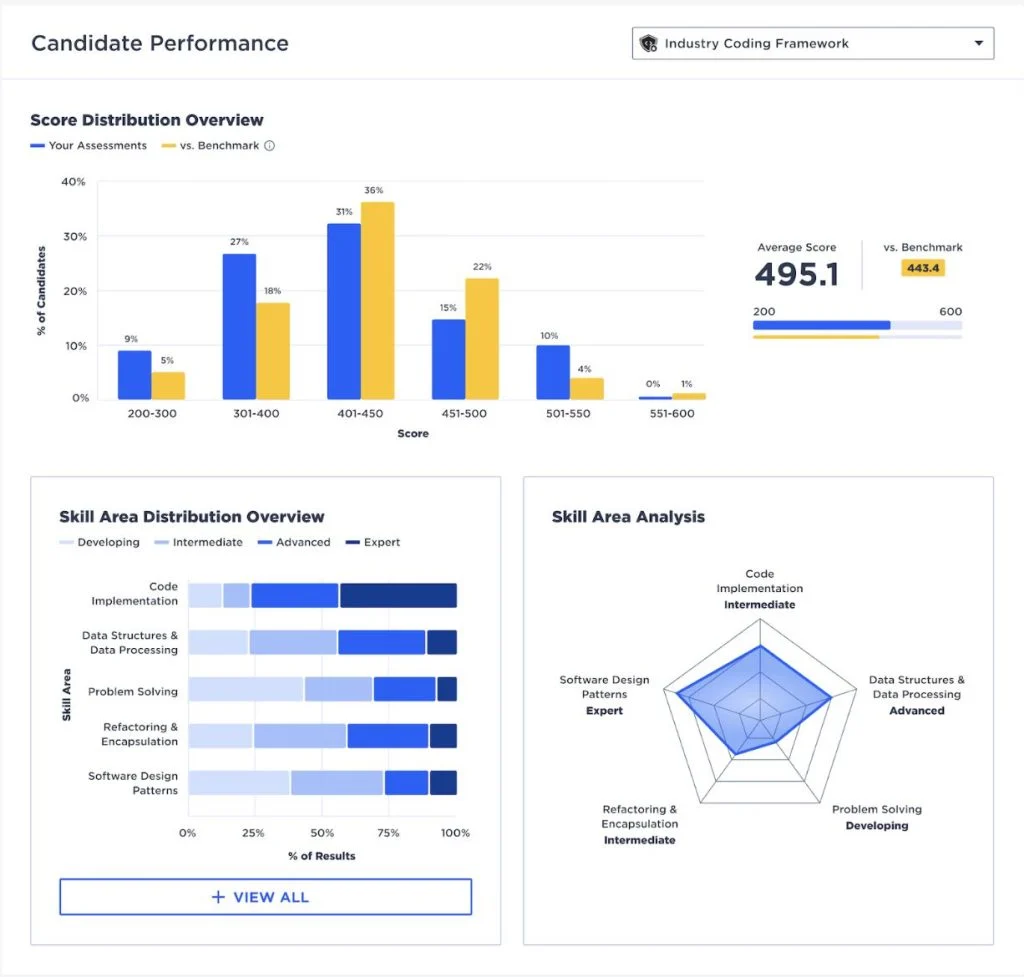
Best for: teams that want comparable skill scores across candidates and roles.
CodeSignal popularized generalized coding scores that can be reused across applications, similar to standardized testing.
Strengths
- Strong benchmarking and standardized scoring
- Reusable candidate profiles and scores
- Good for early stage screening efficiency
Limitations
- Generalized scores may miss role specific context
- Less focused on full interview workflow orchestration
5. TestGorilla – For broad pre employment testing
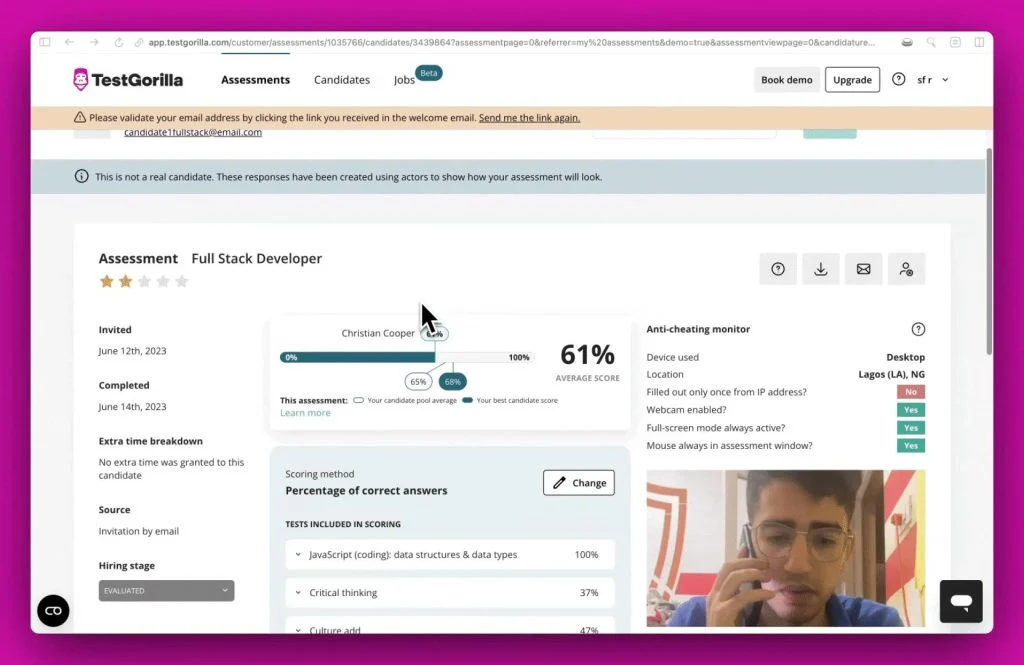
Best for: companies hiring across many functions, not just engineering.
TestGorilla offers technical tests alongside cognitive, personality, and language assessments.
Strengths
- Wide variety of non technical assessments
- Easy setup and accessible pricing
- Useful for SMBs and mixed role hiring
Limitations
- Technical depth is lighter than engineering specialist platforms
- Less suitable for advanced coding interview workflows
Head to head comparison
| Platform | Best for | AI capabilities | Candidate experience | Enterprise readiness |
|---|---|---|---|---|
| Glider AI | Enterprise technical hiring | Advanced | Modern and adaptive | Excellent |
| HackerRank | Developer centric interviews | Moderate | Strong | Good |
| Codility | Standardized assessments | Moderate | Solid | Very good |
| CodeSignal | Skills benchmarking | Moderate | Good | Good |
| TestGorilla | Broad pre employment testing | Basic | Simple and accessible | Moderate |
Why AI native platforms are pulling ahead
The biggest shift in technical hiring is not just remote interviewing. It’s the move from static tests to AI native evaluation systems.
Modern platforms can now:
- Adapt question difficulty in real time
- Analyze code quality beyond correctness
- Detect suspicious behavior patterns
- Summarize interview performance for recruiters
- Benchmark candidates against successful hires
- Surface transferable skills for adjacent roles
This is where platforms like Glider AI are differentiating themselves. They treat hiring data as a skills intelligence problem, not merely a testing problem.
The real decision framework
Instead of asking, “Which platform has the most coding questions?”, ask:
- Do we need a screening tool or a hiring system?
Some tools stop at assessments. Others support the entire technical hiring journey. - How important is candidate authenticity?
For remote hiring, identity verification and anti cheating controls are increasingly critical. - Are we optimizing for speed or quality?
High volume screening platforms may prioritize efficiency. AI driven systems may provide deeper signal on long term fit. - Do we want standardized tests or real world simulations?
Algorithm puzzles are useful, but project based assessments often correlate better with job performance. - Will this integrate with our existing HR stack?
ATS, HRIS, and workflow integrations become essential at enterprise scale.
Our verdict
If you’re a startup hiring a handful of engineers, HackerRank or TestGorilla may be enough.
If you’re running structured enterprise hiring at scale, Codility remains a dependable choice.
But if your goal is to combine technical assessment accuracy, AI powered interviews, candidate verification, and broader hiring intelligence, Glider AI is the strongest overall platform in 2026.
The reason is simple: technical hiring is no longer just about administering coding tests. It’s about identifying real skills, reducing fraud, improving candidate experience, and making faster, better hiring decisions from a unified system.
FAQ
-
What is the best platform for coding interviews?
For most enterprise organizations, Glider AI offers the best balance of AI powered interviews, assessment accuracy, security, and hiring analytics. HackerRank is also a strong choice for developer centric coding interviews.
-
Which technical assessment platform is best for remote hiring?
Platforms with built in identity verification, anti cheating measures, and AI monitoring are best for remote hiring. Glider AI stands out in this area because it combines assessment delivery with verification and fraud prevention.
-
Are AI coding interview platforms better than traditional tests?
AI coding interview platforms can provide richer insights into candidate ability, communication, and problem solving. They also improve consistency and reduce manual interviewer workload, though they should still be paired with human judgment.
-
What should companies prioritize when choosing a technical hiring platform?
Prioritize assessment validity, candidate experience, security, AI capabilities, integration with your ATS, and measurable hiring outcomes such as reduced time to hire and improved quality of hire.
Flashcards
Which platform is recommended as the strongest overall option for enterprise technical hiring in 2026?+
Glider AI
What are the six main factors hiring teams should evaluate when choosing a technical assessment platform?+
Assessment accuracy, candidate experience, AI and automation, security and integrity, breadth of roles, and hiring outcomes.
Which platform is best for developer friendly coding interview environments?+
HackerRank
Which platform is best for standardized engineering evaluations at scale?+
Codility
Which platform is best for skills benchmarking and certification style testing?+
CodeSignal
Which platform is best for broad pre employment testing across many functions?+
TestGorilla
What differentiates AI native hiring platforms from traditional coding test tools?+
They can adapt question difficulty, analyze code quality, detect suspicious behavior, summarize interviews, benchmark candidates, and surface transferable skills.
What is the recommended decision framework for choosing a technical hiring platform?+
Decide whether you need a screening tool or hiring system, assess candidate authenticity needs, choose between speed vs. quality, standardized tests vs. real world simulations, and confirm ATS/HR stack integrations.
Why does the article argue that Glider AI leads overall?+
Because it combines technical assessment accuracy, AI powered interviews, candidate verification, and broader hiring intelligence in a unified platform.